Please click the pictures to visit my other blogs:
Musings from the World of Jewel Scarves for Cambodia Journals for the Journey

Thursday, November 18, 2010

The Unreached People of Cambodia


The estimated 2010 population of Cambodia is 15,050,000. There are 42 people groups in Cambodia; 30 groups remain unreached, at 71.4% of the population. A people group is defined as "A significantly large sociological grouping of individuals who perceive themselves to have a common affinity with one another," whether it be language, ethnicity, or impairment such as deafness, etc.

In many parts of the world lack of understandability serves as the main barrier to evangelism; however, in Cambodia and other parts of Southeast Asia, acceptance is a greater barrier than understandability. 85.1% of Cambodians claim to be Buddhist; however, similar to Christianity in the States, many Buddhists are nominal (one who claims to be Buddhist but is non-practicing) or are "holiday Buddhists" (ie. attend the wats on Buddha Day and other major Buddhist holidays.) 7.8% follow ethnic religions, 2.1% are Islamic, 1.3% claim Christianity (of which .5% are Evangelistic), .2% are Hindus, and the remaining percentage is other, non-religious, or unknown.

Click HERE to read more statistics and information about the unreached people groups of Cambodia.


Love love love, Jewel

Monday, November 15, 2010

Teaching English

If I spent my entire life teaching English, I would be happy. I enjoy it so much. My students across Cambodia and in Mozambique have always been so eager to learn.

I am by no means well-trained in TESOL (Teaching English to Speakers of Other Languages,) but I am well-experienced and I have found a variety of techniques that are very fun and effective! Last summer I collected a large variety of small toys that I used to teach colors, animals, foods, etc. My bff Loren made awesome alphabet cards and my students really enjoyed moving around to arrange themselves in order, and especially enjoyed the foam alphabet puzzles that I found at the Dollar Store.


I equally enjoy especially enjoy teaching the more advanced students. I have taught a variety of grammar concepts, and vocabulary. I have even used children's stories and other stories to practice comprehension. Stories are also a good way to introduce Scripture and Biblical teaching. When I read stories with my students at the World Hope school in Kratie last summer, one student always asked: "What does this teach us about how to behave?" and that would lead into Biblical teaching.

Anything that you would learn in Spanish or French or German class, we employ in TESOL. When I have available free time, I Google ideas, techniques, and resources. I enjoy teaching English very much, and it really is an effective ministry opportunity because relationships can be built easily in the classroom, especially when students are so eager to learn. In fact, many churches and ministry centers are planted in Cambodia (and in other countries) through establishing English classes, which is why the WBI and Bible College of Xai Xai require students to study English.

Love love love, Jewel

Thursday, November 11, 2010

Bound for the States!

I received this message yesterday from my good friend Channy Rasmussen, daughter of Rev. Kung Kimsan, formerly the Superintendent of the Wesleyan Church in Cambodia. Jeff and Channy were married in Phnom Penh on December 12, 2009, with Jeff's parents and brother in attendance.

Thank you so much for your praying for me very hard. I really thank the Lord He is faithful to me and He so good for His children. I knew that He dwelled in my mouth so when the Us embassy asked me some questions and i have ability answered to him quickly and no afraid, I thought he going to speak Khmer to me but not, and he is Indian American, it's not American do interview me. It was very surprised and i was thinking how can i listen to him but i knew that God never leave me alone He always with me. Thanks God! I was very excited in the end of the interview he said you can come back and get your passport back (get visa for visit) it's made me very happy and i asked him again can i get visa? yes, and he said last time and asked me so you go with your husband and come back with your husband right? i said yes... Thanks again for put me in your concerning. God bless you guy. Love you lots.

Channy Rasmussen.


I'm so excited for Channy and I am proud of her for excelling in her interview! I am even more excited for Jeff, because I understand how anxious he is to introduce Channy to his family and friends, and to his country. I am already dreaming about the day that Titus will come to America, and dreaming about the day that my cherished family and friends will visit me in Cambodia.

Love love love, Jewel

Wednesday, November 10, 2010

Genocide in Cambodia

Warning: This is sad and could be considered disturbing.

The Khmer Rouge - the name given to the followers of the Communist Party of Kampuchea, which was the ruling party in Cambodia from 1975 to 1979, led by Pol Pot (Prime Minister.) The Khmer Rouge subjected Cambodia to a radical social reform process that was aimed at creating a purely agrarian-based Communist society. The urban-dwellers were deported to the countryside, where they were combined with the local population and subjected to forced labor. About 2 million Cambodians (or 21% of the population) are estimated to have died in waves of murder, torture, and starvation, aimed particularly at the educated and intellectual elite.

The Khmer Rouge wanted to eliminate anyone suspected of "involvement in free-market activities." Suspected capitalists encompassed professionals and almost everyone with an education, many urban dwellers, and people with connections to foreign governments. In addition, the Khmer Rouge believed parents were tainted with capitalism. Consequently, children were separated from parents and brainwashed to socialism as well as taught torture methods with animals. Children were a "dictatorial instrument of the party" and were given leadership in torture and executions.

One of their mottoes, in reference to urban-dwellers, was:
"To keep you is no benefit. To destroy you is no loss."
Understandably, Cambodia has had a rough recovery after losing the large majority of the educated population.

The Tuol Sleng Genocide Museum: The buildings at Tuol Sleng have remained preserved as they were when the Khmer Rouge were driven out in 1979; in fact, the museum opened in 1980 "as is."
The site is a former high school which was used as the notorious Security Prison 21 by the Khmer Rouge communist regime from 1975 to 1979. Tuol Sleng means "Hill of the Poisonous Trees." The buildings were enclosed in electrified barbed wire, the classrooms converted into tiny prison and torture chambers, and all windows were covered with iron bars and barbed wire to prevent escapes. At any one time, the prison held between 1,000–1,500 prisoners.

Chum Mey is one of only twelve known survivors of the Khmer Rouge imprisonment in the S-21 Tuol Sleng camp, where between 17,000 and 20,000 Cambodians were sent for execution. He survived two years of torture and his life was only spared because of his high level of competence in machine repair for Pol Pot's soldiers. I was humbled to meet him in 2009. In the picture above, he is pointing to a picture of himself alongside other prisoners. This year Bong Chum Mey will be 80-years-old.

Security Regulations
When prisoners were first brought to Tuol Sleng, they were made aware of ten rules that they were to follow during their incarceration. What follows is what is posted today at the Tuol Sleng Museum; the imperfect grammar is a result of faulty translation from the original Khmer:
  • 1. You must answer accordingly to my question. Don’t turn them away.
  • 2. Don’t try to hide the facts by making pretexts this and that, you are strictly prohibited to contest me.
  • 3. Don’t be a fool for you are a chap who dare to thwart the revolution.
  • 4. You must immediately answer my questions without wasting time to reflect.
  • 5. Don’t tell me either about your immoralities or the essence of the revolution.
  • 6. While getting lashes or electrification you must not cry at all.
  • 7. Do nothing, sit still and wait for my orders. If there is no order, keep quiet. When I ask you to do something, you must do it right away without protesting.
  • 8. Don’t make pretext about Kampuchea Krom in order to hide your secret or traitor.
  • 9. If you don’t follow all the above rules, you shall get many many lashes of electric wire.
  • 10. If you disobey any point of my regulations you shall get either ten lashes or five shocks of electric discharge.

Left: Inside the small cell there are shackles for the hands and feet; a bowl for food, and a box for relieving oneself. The prisoners received four small spoonfuls of rice porridge and watery soup of leaves twice a day, and were hosed off once every four days.
Right: Sign reads: "Killing tree against which executioners beat children." In a pile at the base of the tree are bones.

Upon arrival at the prison, prisoners were photographed. Several rooms of the museum are now lined, floor to ceiling, with black and white photographs of some of the estimated 20,000 prisoners who passed through the prison.


By December 1978, because of several years of border conflict and the flood of refugees fleeing Cambodia, relations between Cambodia and Vietnam collapsed. Pol Pot, fearing a Vietnamese attack, ordered a pre-emptive invasion of Vietnam. His Cambodian forces crossed the border and looted nearby villages. These Cambodian forces were repulsed by the Vietnamese.
Then, alongside many dissatisfied former Khmer Rouge members, the Vietnamese armed forces invaded Cambodia, capturing Phnom Penh on January 7, 1979. Despite a traditional Cambodian fear of Vietnamese domination, defecting Khmer Rouge activists assisted the Vietnamese, and, with Vietnam's approval, became the core of the new People's Republic of Kampuchea, quickly dismissed by the Khmer Rouge and China as a "puppet government".

In 1985 Vietnam declared that it would complete the withdrawal of its forces from Cambodia by 1990 and did so in 1989, having allowed the government that it had instated there to consolidate and gain sufficient military strength.

Since 1990 Cambodia has gradually recovered, demographically and economically, from the Khmer Rouge regime, although the psychological scars affect many Cambodian families and émigré communities. It is noteworthy that Cambodia has a very young population and by 2003 three-quarters of Cambodians were too young to remember the Khmer Rouge era.

Members of this younger generation may know of the Khmer Rouge only through word of mouth from parents and elders. In part, this is because the government does not require that educators teach children about Khmer Rouge atrocities in the schools.

Click: HERE for more information about Toul Sleng,
HERE for more information about the Khmer Rouge,
and HERE for more information about Pol Pot.

Love love love, Jewel

Tuesday, November 9, 2010

Food

My favorite fruit: the mangosteen - a delicious fruit grown on tropical evergreens in Southeast Asia. The taste is really unique and hard to describe; it's sweet and tangy, with the texture of a peach. To open the fruit you pinch at the top by the green stem, cracking the rind, and pulling the soft shell open. The white inside breaks apart like orange slices; those slimy white pieces are the good stuff! Avoid eating the rind; it's really bitter. I understand that presently the U.S.D.A. does not allow the mangosteen to enter the U.S., but they are gradually making their appearance in Asian and International markets in New York City, Chicago and Los Angeles for anywhere between $4-$11.
Other popular fruits include: the jan fruit, kuy fruit, romduol, pineapple, star apple, rose apple, coconut, palmyra fruit, jackfruit, papaya, watermelon, banana, mango and rambutans. Although fruits are usually considered desserts, some fruits such as: mangoes, watermelon, and pineapples are eaten commonly with fish or with plain rice. Popular fruits for shakes are durian, mangoes, and bananas.

Below is a sticky rice cake with mung bean; it is a recipe for special occasions (i.e. weddings.) I was initially hesitant to try it -- since it looks like a thick, cloudy, white jello, and is wrapped in a moist, warm banana leaf -- but it really is very good! There are many varieties of this recipe; I hope Vandy's mum will teach me how to make it!

If you watch Fear Factor, maybe you have seen balut. Balut is a fertilized duck egg with a nearly-developed embryo (aka: baby duck) inside that is boiled and eaten in the shell. "A combination of saltiness and tartness, softness and crunchiness, a sensation of sweetness, the degree of resistance to the bite, the viscosity and stickiness are the rewards."

The staple food for Cambodians is rice. Almost every meal includes a bowl of rice, although noodles are also popular. A wide range of curries, soups and stir fries are served with rice.

Vegetables like mushrooms, cabbage, corn, bamboo shoots, fresh ginger, broccoli, and snow are commonly used in many different stir fry dishes.

Fish is the most common form of meat in Khmer cuisine. Pork is also very popular. Beef and chicken are stewed, grilled or stir fried. Seafood includes an array of shellfish like clams, cockles, crayfish, shrimp and squid; lobsters are not commonly eaten because of their price. Roasted duck is popular during festivals. More unusual meats include: dog, frog, rat, snake, tarantula, and cricket.

Chicken fingers has a whole new meaning!


Love love love, Jewel

Sunday, November 7, 2010

Missionaries to Cambodia

I am privileged to work beside a wonderful team of pastors and missionaries in Phnom Penh and around Cambodia. There are currently three Wesleyan missionary families on the field, and here is just a little about them.


Tim and Tiffany Gallant and baby Katie
Tim and Tiffany are the reason I initially chose to go to Cambodia (although there were many prayers given to the decision, and eventually I felt God's peace.) When they are in town, they attend my home church, and we have many memories together - both stateside and in Cambodia. I am blessed to share a love for Cambodia with these two!
You can read the Gallant Gazette HERE


Greg and Resie Fernandez, Aleeyah and Esher
Greg and Resie are two of the most passionate missionaries people that I ever met. They are also very wise, disciplined, and humble. They are two of my biggest challengers and two of my biggest encouragers. They previously taught at the WBI, but are now involved in Church ministries and outreach. Because of their specific ministry field, I will be working more closely with the Fernandezes when I am in Cambodia.
You can read Resie's blog HERE
Greg's blog HERE
and Aleeyah & Esher's blog HERE


Chet, Virginia, and Bekah Quinn
The Quinns are from Kentwood Community Church in Kentwood, Michigan, and are maybe ten months through what I believe is a two-year assignment. Chet teaches computer at the Wesleyan Bible Institute, and Virginia volunteers at Daughters of Cambodia, a faith-based non-Government organization reaching out to victims of sex trafficking in Cambodia. I'm anxious to meet them in December!
You can read the Quinns' blog HERE

Friday, November 5, 2010

The Russian Market

The Russian Market is popular among tourists, local expatriates, and Cambodians. It is located in southern Phnom Penh, and is named for its popularity among Russian expatriates during the 1980s. It is a large indoor market hundreds of stalls.

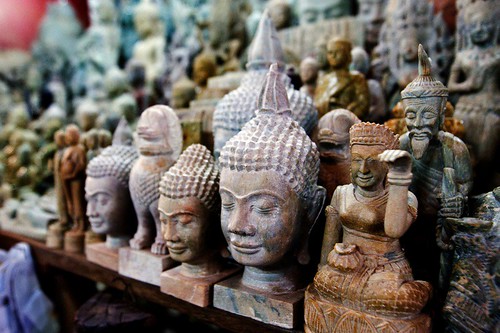
Inside you can find hardware goods, drinks and cooked food, antique furniture, traditional carvings and handicraft, hand-woven silk, music, movie and computer CDs, silverware, gems, books and maps, backpacks and bags, and shoes and clothing, etc., etc., etc.. Everything you would want! (Except, strangely enough, moto helmets! Right Zoey?) Some shoes and clothing come from various local garment factories, hence some top labels (Puma, Northface, Hollister, etc.) can be found at very reasonable prices. Actually, everything is very reasonable and all vendors expect customers to barter prices.

For any American, shopping in a foreign market is quite the experience.

Outside:Fruits and vegetables::
DVDS:: (3 for $5)Traditional Handicrafts::
Meats::

Silver
and much much more::

The smells are distinct, the sounds are distinct, and the people are distinct. I could [and have] walked around for hours, observing, just taking everything in. I still remember a young boy I met there last summer; he was selling books about Cambodia, and selling cards painted by victims of landmines. There is also the sweetest, most precious man in the cafe area that claims to serve Phnom Penh's best iced coffee [and he does by the way.] So if you're ever in the Russian Market, find the man with the big smile and all the flags! It's clean, delicious, cheap, and strong! You will definitely get all the caffine you need to shop until you drop!

Here he is:
Mr. Bounnareth


Love love love, Jewel

Wednesday, November 3, 2010

God, I'll Follow You

Two favorite artists. One favorite country. One beautiful song.
God, thank you for calling me to Cambodia!


...All my needs you have supplied.
When I was dead you gave me life.
How could I not give it away so freely?

And I'll follow you into the homes that are broken.
Follow you into the world.
Meet the needs for the poor and the needy God.
Follow you into the World.

Use my hands, use my feet
To make your kingdom come
Through the corners of the earth
Until your work is done
'Cause Faith without works is dead
And on the cross your blood was she'd
So how could I not give it away so freely?...

Tuesday, November 2, 2010

Scarves


My second shipment of Cambodia scarves are in! Thank you to Resie for purchasing the scarves, and to Umfundisi for bringing them back to Indiana for me. This fundraiser has been bigger than I ever imagined it would be. I sold 40 scarves two months ago, and I sold nineteen in only three hours last night!

Love love love, Jewel

Monday, November 1, 2010

City, Countryside, and Between

Although I'm more likely to end up settling in the big and busy capital city of Phnom Penh, this is the Cambodia I love -- the countryside. Traditional architecture includes the stilt house, built with a wooden frame and a steep thatched roof overhanging the walls. These stilt houses are up to 9 feet off the ground to protect against floods, while providing shelter for the family's domestic animals below the house.

Angkor Wat is a temple complex in Siem Reap, built for the king in the early 12th century as his state temple and capital city. The above picture was taken at Bayon, my favorite temple at Angkor Wat. The temple complex is absolutely phenomenal; in fact, it's one of the wonders of the ancient world. Around five hours from Phnom Penh, Cambodians have much pride in Angkor Wat, and it is even featured on the Cambodian flag. You can anticipate an entire post dedicated to Angkor Wat in the semi-near future..

Like in any nation, life in the city certainly contrasts life in the country. This scene is typical in Phnom Penh, where houses are built small, but upwards. Phnom Penh, meaning "full mountain," was known in the 1920s as the "Pearl of Asia." The capital is the wealthiest and most populous city in Cambodia, home to more than two million of Cambodia's population of over fourteen million. It is home to the country's political hub, and is a significant global and domestic tourist destination.

Khmer sunsets are stunning. When I lived at the WBI, I was blessed with an incredible view of the West and was amazed to see the sun set early every evening.

Love love love, Jewel